Think & Discuss
Quick Check
Inquiry Task
Key points: According to this page, modern banks need not first hand over a specific depositor's money as is; they can record a deposit or purchasing power for the borrower on their books, provided they trust that the borrower's future income will repay principal and interest. Therefore, what underpins credit is not only present gold and silver, but also trust in the future. At the same time, limitations should be noted: real banks are constrained by reserve requirements, capital adequacy ratios, and regulatory rules. This example is a teaching model for understanding how trust underpins credit, not a complete description of how real bank balance sheets operate.
Key points: This echoes the claim that reinvesting profits into production brings economic growth; the author further summarizes this claim as growth being nearly the supreme good. As for the distinction, wealth refers to money, goods, and resources that are buried underground or wasted on non-productive activities, while capital refers to money, goods, and resources that are invested in production to generate more profit: the same sum of money counts as wealth if hidden away and not invested in production, but becomes capital if used to invest in factories or buy stocks. One may also add: such formulations are an overview of a particular economic doctrine, not accepted by all societies, and critics emphasize its distributive and ecological costs.
Grading criteria (open-ended question; multiple positions allowed; the key is reasoning and evidence, not the conclusion itself): ① Does the response explain the explanatory power of a single-theme generalization — for instance, that it captures sustained growth as a salient feature of the modern economy and connects it to credit, trust, and profit reinvestment? ② Does it point out the costs of generalizing — for example, personifying the economy as an agent with a single will, ignoring institutional and policy differences, or overlooking distributive inequality and cultural differences? ③ Does it cite phenomena that might weaken the generalization — such as repeated financial crises and economic stagnation, the costs of colonial plunder and ecological destruction, the long-term absence of sustained growth in premodern and non-capitalist societies, or stark differences in growth rates across regions during the same period? ④ Does it clearly distinguish the author's judgments from verifiable facts and give reasons for its own evaluation? At minimum, one concrete phenomenon must be given with an explanation of why it challenges the generalization.
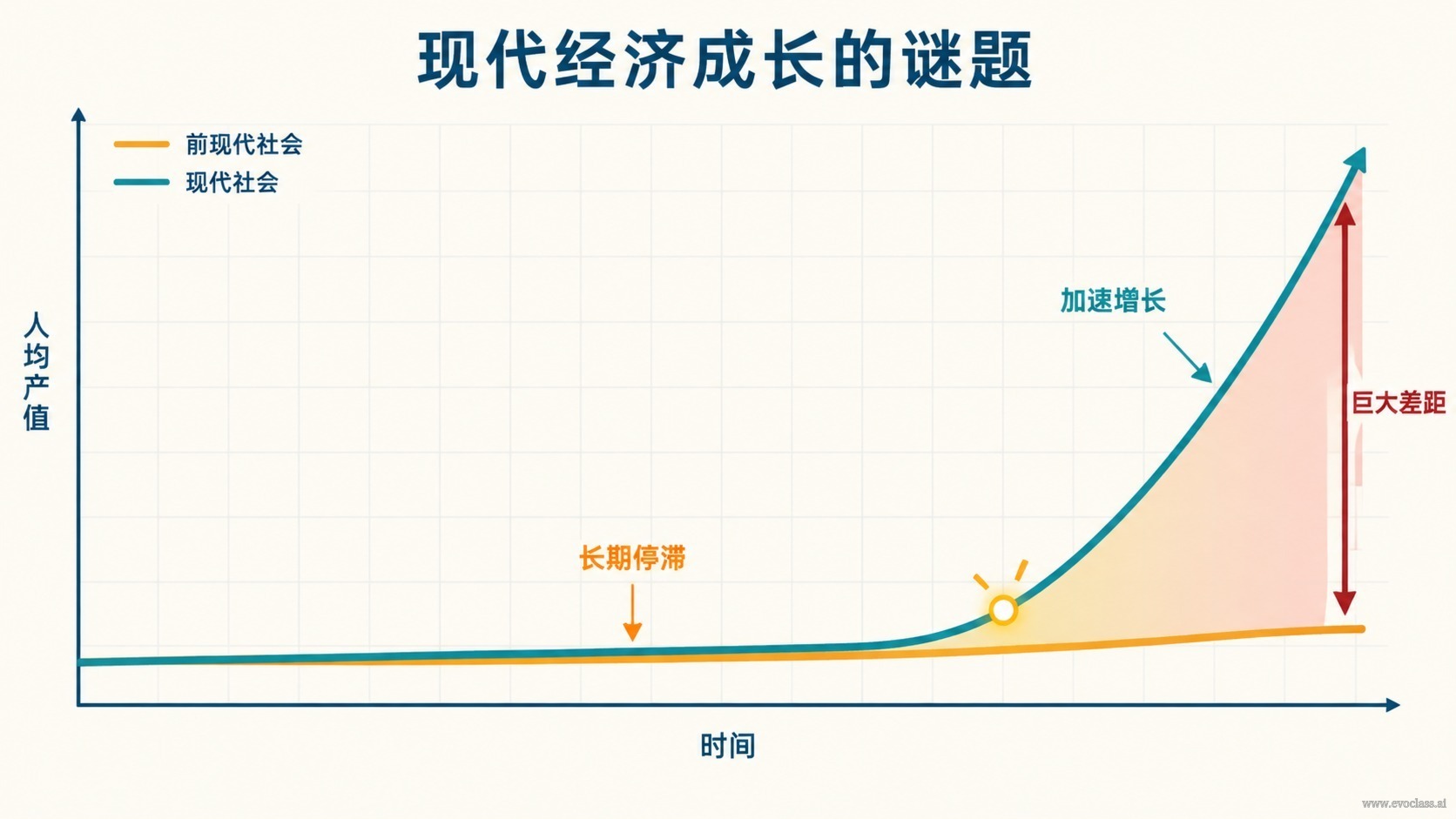
If you draw a long-term trend line for the human economy, you see a peculiar asymmetry: throughout the long premodern era, global output and per capita output fluctuated at low levels, with expansions and contractions alternating but no sustained upward momentum; once the modern era began, however, the economy grew continuously and rapidly, at a speed and scale far beyond anything before.
The author attributes the key that opens this door to a single word:growth. In his account, the core thread of modern economic history is not some war or dynasty, but the fact that growth itself became the norm — whether that growth is ultimately judged healthy or pathological, it keeps expanding like a hormone-fueled teenager, devouring everything it touches at a pace no one can keep up with.
To understand this rupture, we must first look at how premodern people imagined wealth. A view of wealth that was roughlyzero-sumprevailed at the time: total wealth was seen as a roughly fixed stock, so one party's gain was another's loss. Since the future was not expected to be bigger, long-term lending and investment lacked a solid foundation. By contrast, the modern idea of progress holds that tomorrow can be better than today, so future earnings can be drawn upon in advance, and only then can credit and investment expand continuously.
| Comparison Dimension | Premodern Economy | Modern Economy |
|---|---|---|
| View of Wealth | Roughly zero-sum; total seen as fixed | Belief that the total can keep growing |
| Expectations about the Future | Idea of progress not dominant | Expectation of higher future returns |
| Credit and Investment | Difficult to expand continuously | Can be built on future earnings |
| growth | Long-term fluctuation at low levels | Sustained rapid growth becomes the norm |
A caveat: this comparison table organizes a macro-level narrative; it is not a precise statistical conclusion, and actual conditions varied greatly across regions and periods.
Growth does not happen automatically. It requires someone willing to commit present resources to a future that does not yet exist, and this depends mainly on two things: credit and trust.
Imagine a bakery owner. He wants to expand his bakehouse but doesn't have enough cash on hand, so he walks into a bank. According to the common macro-level narrative, the bank does not need to wait for a depositor to haul in gold coins and hand them over; instead, it can record a loan for the owner on its books: the owner immediately gains purchasing power to buy ovens and flour, while the bank recovers principal and interest in installments later. This process of creating purchasing power on the books is an introductory example for understanding how modern finance supplies growth with blood.
Why does the bank dare to do this? Because it trusts that the bread this bakery sells over the coming years will suffice to repay the loan. In other words, what backs credit is not just the gold and silver in front of you, but alsotrust in the future. A note of caution is needed here: real banks are constrained by reserve requirements, capital adequacy ratios, and regulatory rules, and the actual mechanisms are far more complex than this simplified example; it is more appropriate to treat it as a teaching model for understanding how trust underpins credit.
The same logic runs through the capitalist creed. According to the narrative this page draws on, this theory began as a discourse about how the economy works, then gradually moved beyond the economic sphere to become a whole set of ideas about behavior, education, and ways of thinking; its core claim can be summarized as: reinvestprofits into production, and you get rapid economic growth; it even goes further to claim that since justice, freedom, and even happiness all depend on economic growth, growth itself is nearly the supreme good. Paired with this is a key distinction:wealthis static assets, whilecapitalis the portion of wealth invested in production in the expectation of bringing back profit — land, money, and goods are not automatically capital in themselves; they become capital only when used to generate future returns.
It is worth noting: "growth as the supreme good" is a summary of a particular doctrine, not a universally accepted factual judgment. It explains why modern political debates can never avoid growth, and why it invites criticism regarding distribution, ecology, and social costs.
If growth depends on trust in the future, that trust must ultimately be honored by someone. The author points out that under capitalism, when governments and businesses fund scientific research, one of the first questions they ask is often: Can this research increase output and profit? Can it promote economic growth? Research that cannot answer these questions has almost no chance of receiving funding. Thus the history of modern science can hardly avoid the thread of capitalism.
Overseas expansion and organizational forms were likewise driven by the logic of growth. High-risk, high-investment ventures such as ocean exploration and transoceanic trade required enormous capital, so royalty, merchants, and joint-stock companies became sponsors: joint-stock companies pooled scattered funds and spread risk among many shareholders, making oceangoing voyages and colonial trade sustainable. A Columbus-style voyage, too, could only begin after finding a financier.
This also raises a counterintuitive question: a pack of wolves does not expect the flock of sheep to multiply without limit, and most systems in the universe cannot grow indefinitely — so why can the human economy keep expanding throughout the modern era? The author's answer: scientists make new discoveries and inventions every few years, fueling growth with new resources and industries; he even describes it by saying that banks and governments print the money, but scientists ultimately foot the bill. This is an author's judgment rich in explanatory power, but it compresses complex institutional, political, and ecological factors into a single thread, and thus deserves to be discussed alongside other explanations.
Line Chart: Long-Term Trends in Per Capita Output in Premodern vs. Modern SocietiesExamine the line chart: long-term trends in per capita output in premodern vs. modern societies. Think about how it relates to the idea that "the scale of the premodern economy changed little over the long term."